Why Gross Motor Development Is the Foundation of Academic Success
One of the questions I hear most often from parents, especially around admissions time, is this:
“When should we really start focusing on academics?”
It’s a fair question. And I understand the anxiety behind it. You want the best for your child. You don’t want them to fall behind.
But here’s what I’ve come to believe, after years of working with children and educators: before we talk about reading benchmarks or number sense, we need to ask a more fundamental question first.
Is your child’s body ready to learn?
The Body and the Brain Are Not Separate
I know that might sound like an odd place to start. But hear me out.
Neuroscience and the wisdom of educators like Maria Montessori and Jean Piaget tells us clearly: children learn through movement. Not despite it. Through it.
When a child climbs, balances, crawls, or runs, they’re not just “playing.” They’re building the neurological systems that will later support attention, emotional regulation, and even reading fluency.
Dr. Carla Hannaford, a neurophysiologist who wrote Smart Moves, puts it beautifully: movement grows neural connections. When children move with intention, the brain organises itself for thinking.
So before a child can sit still, focus deeply, or write for sustained periods, the body has to be ready to hold them there.
What Slouching Is Really Telling You
Parents sometimes come to me concerned that their child can’t sit still or keeps slouching at the desk. They wonder if it’s a behaviour issue, or attention.
Often, it’s neither.
The work of Dr. A. Jean Ayres on sensory integration shows us that the vestibular system, your child’s internal balance system, plays a huge role in regulating attention and emotional steadiness. When maintaining posture takes effort, the brain is busy just holding the body upright. There’s less bandwidth left for learning.
A stable body supports a focused mind. It really is that simple.
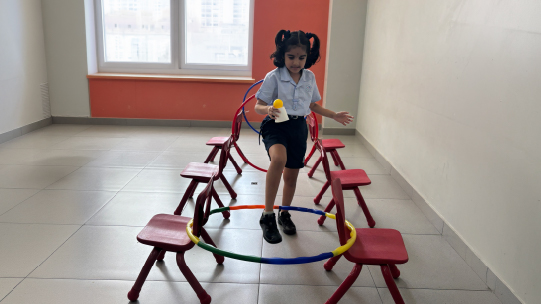
This is why we invest so intentionally in balance, core strength, and movement at GVS. It’s not extracurricular. It’s foundational.
Crawling, Crossing, and Reading. Yes, They’re Connected
Here’s something that surprises a lot of parents: cross-lateral movement, things like crawling or rhythmic patterned activities that cross the body’s midline, actually strengthens the communication between the left and right hemispheres of the brain.
And that integration? It shows up later as reading fluency, writing coordination, logical reasoning, and sequencing ability.
Dr. Adele Diamond’s research on executive function confirms this: physical challenges strengthen working memory, focus, and cognitive flexibility.
In other words, motor planning becomes academic planning. The skills are more connected than they look.
Core Strength Before the Pencil
Occupational therapy has long known something important: proximal stability comes before distal precision.
In plain language, a child needs trunk and shoulder strength before fine motor control develops meaningfully. If the core isn’t stable, handwriting becomes tiring quickly, posture collapses, and endurance drops.
This is why development follows a sequence. Regulation before instruction. Stability before precision. Integration before performance.
We can’t shortcut this. But when we honour it, academic growth follows naturally and sustainably.
What “School Readiness” Actually Means
We’ve somehow come to associate school readiness with early exposure to letters and numbers. I’d gently push back on that.
True readiness is neurological readiness, and it includes emotional regulation, the ability to sustain attention, coordinated brain integration, physical endurance, and the confidence to navigate challenges.
Children who arrive with strong gross motor foundations tend to be more resilient, more focused, and better equipped for the long game of learning.
Movement isn’t a break from learning. It’s the preparation for it.
A Thought I’ll Leave You With
We live in a world that celebrates acceleration. I understand the impulse. I feel it too, as an educator and as someone who cares deeply about children’s futures.
But development cannot be rushed without consequence.
When we strengthen foundations, we don’t delay learning, we deepen it. We make it stick. We make it joyful.
At Ganges Valley School, we’re committed to honouring the sequence of childhood development, because we know that strong bodies support strong minds.
And foundations shape futures.